 Add to Chrome
 Add to Firefox
 Add to Edge
SSR3D-LLM: Structured Spatial Reasoning via Latent Steps for Fine-Grained Grounding in Unified 3D-LLMs
May 27, 2026
3D object grounding localizes referred objects in a 3D scene from natural language. Unified instance-centric 3D-LLMs aim to solve grounding together with dialog, QA, and captioning, yet many rely on a single pointer-style grounding decision that compresses a relational instruction into one selection. This is brittle for fine-grained queries where multiple same-class candidates must be ruled out by context objects and spatial relations. We propose Structured Spatial Reasoning 3D-LLM (SSR3D-LLM), a structured grounding interface for unified 3D-LLMs. Given fixed Mask3D object proposals, the LLM writes a sequence of latent spatial reasoning steps and memory tokens from the query, and a geometry-aware scorer reads these latent steps in order to refine candidate rankings step by step with step-length masking. The latent steps are learned from standard benchmark target supervision with auxiliary referential-cue supervision during training, while inference uses only the input query and Mask3D proposals. Across ReferIt3D, ScanRefer, and Multi3DRef, SSR3D-LLM achieves the strongest results among unified 3D-LLM baselines, with substantial gains over the single-pointer QPG baseline on fine-grained grounding and consistent improvements over prior unified 3D-LLMs, while preserving the default language-task route.

Cognitive-Uncertainty Guided Knowledge Distillation for Accurate Classification of Student Misconceptions
May 14, 2026Accurately identifying student misconceptions is crucial for personalized education but faces three challenges: (1) data scarcity with long-tail distribution, where authentic student reasoning is difficult to synthesize; (2) fuzzy boundaries between error categories with high annotation noise; (3) deployment parado-large models overlook unconventional approaches due to pretraining bias and cannot be deployed on edge, while small models overfit to noise. Unlike traditional methods that increase diversity through large-scale data synthesis, we propose a two-stage knowledge distillation framework that mines high-value samples from existing data. The first stage performs standard distillation to transfer task capabilities. The second stage introduces a dual-layer marginal selection mechanism based on cognitive uncertainty, identifying four types of critical samples based on teacher model uncertainty and confidence differences. For different data subsets, we design difficulty-adaptive mechanism to balance hard/soft label contributions, enabling student models to inherit inter-class relationships from teacher soft labels while distinguishing ambiguous error types. Experiments show that with augmented training on only 10.30% of filtered samples, we achieve MAP@3 of 0.9585 (+17.8%) on the MAP-Charting dataset, and using only a 4B parameter model, we attain 84.38% accuracy on cross-topic tests of middle school algebra misconception benchmarks, significantly outperforming sota LLM (67.73%) and standard fine-tuned 72B models (81.25%). Our code is available at https://github.com/RoschildRui/acl2026_map.
LoopGuard: Breaking Self-Reinforcing Attention Loops via Dynamic KV Cache Intervention
Apr 11, 2026Through systematic experiments on long-context generation, we observe a damaging failure mode in which decoding can collapse into persistent repetition loops. We find that this degeneration is driven by collapsed attention patterns, where a subset of heads locks onto a narrow suffix of the history, and is further stabilized by inference-time KV cache reuse. Crucially, since many existing KV cache policies rely on attention-based importance, this collapse can produce spuriously high scores for repetitive tokens, causing cache management to inadvertently amplify repetition. To study this phenomenon in a controlled and reproducible manner, we introduce LoopBench, a benchmark with explicit loop-inducing conditions and loop-oriented metrics that quantify repetition severity and generation instability beyond downstream task scores. Building on these insights, we propose LoopGuard, a lightweight, plug-in KV cache guard that detects loop onset online and disrupts the feedback cycle by pruning repetitive tail spans under a fixed cache budget. Experiments on LoopBench show that LoopGuard reduces loop incidence by over 90 percentage points, while restoring output diversity and reducing token waste.
Head-wise Modality Specialization within MLLMs for Robust Fake News Detection under Missing Modality
Apr 08, 2026Multimodal fake news detection (MFND) aims to verify news credibility by jointly exploiting textual and visual evidence. However, real-world news dissemination frequently suffers from missing modality due to deleted images, corrupted screenshots, and similar issues. Thus, robust detection in this scenario requires preserving strong verification ability for each modality, which is challenging in MFND due to insufficient learning of the low-contribution modality and scarce unimodal annotations. To address this issue, we propose Head-wise Modality Specialization within Multimodal Large Language Models (MLLMs) for robust MFND under missing modality. Specifically, we first systematically study attention heads in MLLMs and their relationship with performance under missing modality, showing that modality-critical heads serve as key carriers of unimodal verification ability through their modality specialization. Based on this observation, to better preserve verification ability for the low-contribution modality, we introduce a head-wise specialization mechanism that explicitly allocates these heads to different modalities and preserves their specialization through lower-bound attention constraints. Furthermore, to better exploit scarce unimodal annotations, we propose a Unimodal Knowledge Retention strategy that prevents these heads from drifting away from the unimodal knowledge learned from limited supervision. Experiments show that our method improves robustness under missing modality while preserving performance with full multimodal input.
Low-Complexity RSS-based Underwater Localization with Unknown Transmit Power
Jan 18, 2026Underwater wireless sensor networks (UWSNs) have received significant attention due to their various applications, with underwater target localization playing a vital role in enhancing network performance. Given the challenges and high costs associated with UWSN deployments, Received Signal Strength (RSS)-based localization offers a viable solution due to its minimal hardware requirements and cost-effectiveness. In this paper, we assign distance-based weights to RSS measurements, providing higher reliability to closer anchor nodes. Using the weighted RSS measurements and generalized trust region subproblem (GTRS), we propose the GTRS-based localization technique with Unknown Transmit Power (GUTP), which can be solved by a simple bisection method. Unlike conventional localization methods that require prior knowledge of the target node's transmit power, GUTP jointly estimates both the location and transmit power of the target node, broadening its practical use. Additionally, we derive the Cramer-Rao lower bounds (CRLBs) for RSS-based underwater localization with known and unknown transmit power, respectively. Extensive simulations demonstrate that GUTP achieves enhanced accuracy and significantly lower computational complexity in estimating the target node's location and transmit power compared to existing semidefinite programming (SDP)-based techniques.
R$^3$L: Reflect-then-Retry Reinforcement Learning with Language-Guided Exploration, Pivotal Credit, and Positive Amplification
Jan 07, 2026Reinforcement learning drives recent advances in LLM reasoning and agentic capabilities, yet current approaches struggle with both exploration and exploitation. Exploration suffers from low success rates on difficult tasks and high costs of repeated rollouts from scratch. Exploitation suffers from coarse credit assignment and training instability: Trajectory-level rewards penalize valid prefixes for later errors, and failure-dominated groups overwhelm the few positive signals, leaving optimization without constructive direction. To this end, we propose R$^3$L, Reflect-then-Retry Reinforcement Learning with Language-Guided Exploration, Pivotal Credit, and Positive Amplification. To synthesize high-quality trajectories, R$^3$L shifts from stochastic sampling to active synthesis via reflect-then-retry, leveraging language feedback to diagnose errors, transform failed attempts into successful ones, and reduce rollout costs by restarting from identified failure points. With errors diagnosed and localized, Pivotal Credit Assignment updates only the diverging suffix where contrastive signals exist, excluding the shared prefix from gradient update. Since failures dominate on difficult tasks and reflect-then-retry produces off-policy data, risking training instability, Positive Amplification upweights successful trajectories to ensure positive signals guide the optimization process. Experiments on agentic and reasoning tasks demonstrate 5\% to 52\% relative improvements over baselines while maintaining training stability. Our code is released at https://github.com/shiweijiezero/R3L.
E3-Rewrite: Learning to Rewrite SQL for Executability, Equivalence,and Efficiency
Aug 12, 2025SQL query rewriting aims to reformulate a query into a more efficient form while preserving equivalence. Most existing methods rely on predefined rewrite rules. However, such rule-based approaches face fundamental limitations: (1) fixed rule sets generalize poorly to novel query patterns and struggle with complex queries; (2) a wide range of effective rewriting strategies cannot be fully captured by declarative rules. To overcome these issues, we propose using large language models (LLMs) to generate rewrites. LLMs can capture complex strategies, such as evaluation reordering and CTE rewriting. Despite this potential, directly applying LLMs often results in suboptimal or non-equivalent rewrites due to a lack of execution awareness and semantic grounding. To address these challenges, We present E3-Rewrite, an LLM-based SQL rewriting framework that produces executable, equivalent, and efficient queries. It integrates two core components: a context construction module and a reinforcement learning framework. First, the context module leverages execution plans and retrieved demonstrations to build bottleneck-aware prompts that guide inference-time rewriting. Second, we design a reward function targeting executability, equivalence, and efficiency, evaluated via syntax checks, equivalence verification, and cost estimation. Third, to ensure stable multi-objective learning, we adopt a staged curriculum that first emphasizes executability and equivalence, then gradually incorporates efficiency. Extensive experiments show that E3-Rewrite achieves up to a 25.6\% reduction in query execution time compared to state-of-the-art methods across multiple SQL benchmarks. Moreover, it delivers up to 24.4\% more successful rewrites, expanding coverage to complex queries that previous systems failed to handle.
FinGAIA: An End-to-End Benchmark for Evaluating AI Agents in Finance
Jul 23, 2025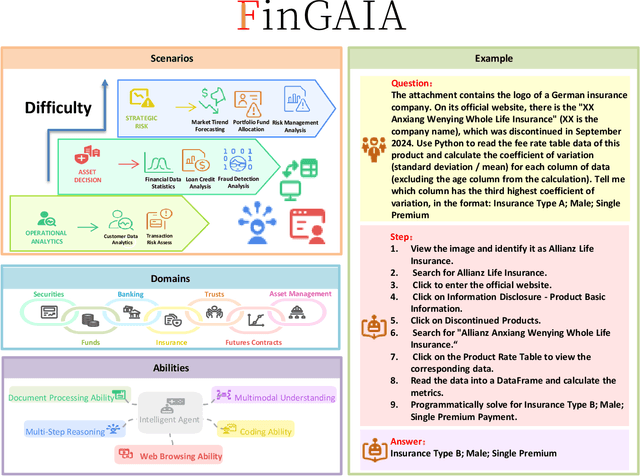
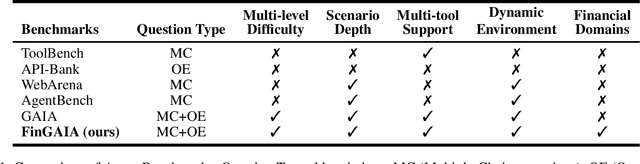
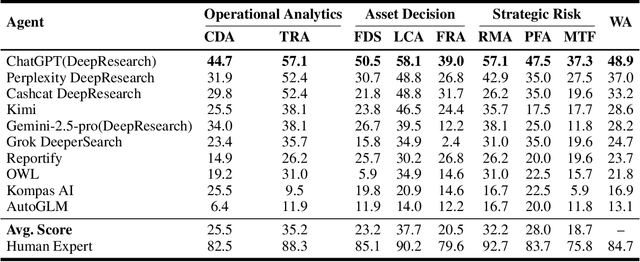
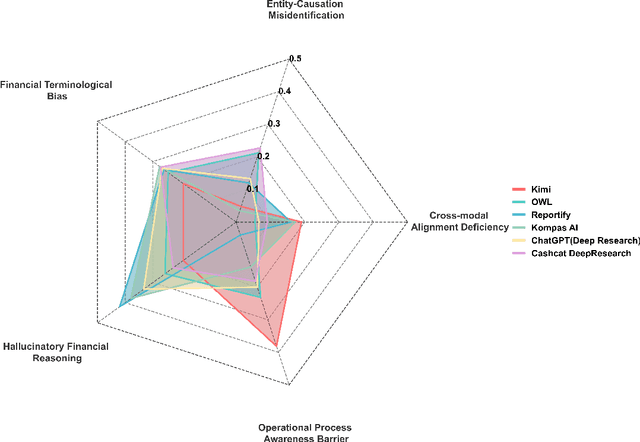
The booming development of AI agents presents unprecedented opportunities for automating complex tasks across various domains. However, their multi-step, multi-tool collaboration capabilities in the financial sector remain underexplored. This paper introduces FinGAIA, an end-to-end benchmark designed to evaluate the practical abilities of AI agents in the financial domain. FinGAIA comprises 407 meticulously crafted tasks, spanning seven major financial sub-domains: securities, funds, banking, insurance, futures, trusts, and asset management. These tasks are organized into three hierarchical levels of scenario depth: basic business analysis, asset decision support, and strategic risk management. We evaluated 10 mainstream AI agents in a zero-shot setting. The best-performing agent, ChatGPT, achieved an overall accuracy of 48.9\%, which, while superior to non-professionals, still lags financial experts by over 35 percentage points. Error analysis has revealed five recurring failure patterns: Cross-modal Alignment Deficiency, Financial Terminological Bias, Operational Process Awareness Barrier, among others. These patterns point to crucial directions for future research. Our work provides the first agent benchmark closely related to the financial domain, aiming to objectively assess and promote the development of agents in this crucial field. Partial data is available at https://github.com/SUFE-AIFLM-Lab/FinGAIA.
LegalReasoner: Step-wised Verification-Correction for Legal Judgment Reasoning
Jun 09, 2025Legal judgment prediction (LJP) aims to function as a judge by making final rulings based on case claims and facts, which plays a vital role in the judicial domain for supporting court decision-making and improving judicial efficiency. However, existing methods often struggle with logical errors when conducting complex legal reasoning. We propose LegalReasoner, which enhances LJP reliability through step-wise verification and correction of the reasoning process. Specifically, it first identifies dispute points to decompose complex cases, and then conducts step-wise reasoning while employing a process verifier to validate each step's logic from correctness, progressiveness, and potential perspectives. When errors are detected, expert-designed attribution and resolution strategies are applied for correction. To fine-tune LegalReasoner, we release the LegalHK dataset, containing 58,130 Hong Kong court cases with detailed annotations of dispute points, step-by-step reasoning chains, and process verification labels. Experiments demonstrate that LegalReasoner significantly improves concordance with court decisions from 72.37 to 80.27 on LLAMA-3.1-70B. The data is available at https://huggingface.co/datasets/weijiezz/LegalHK.
Towards DS-NER: Unveiling and Addressing Latent Noise in Distant Annotations
May 18, 2025Distantly supervised named entity recognition (DS-NER) has emerged as a cheap and convenient alternative to traditional human annotation methods, enabling the automatic generation of training data by aligning text with external resources. Despite the many efforts in noise measurement methods, few works focus on the latent noise distribution between different distant annotation methods. In this work, we explore the effectiveness and robustness of DS-NER by two aspects: (1) distant annotation techniques, which encompasses both traditional rule-based methods and the innovative large language model supervision approach, and (2) noise assessment, for which we introduce a novel framework. This framework addresses the challenges by distinctly categorizing them into the unlabeled-entity problem (UEP) and the noisy-entity problem (NEP), subsequently providing specialized solutions for each. Our proposed method achieves significant improvements on eight real-world distant supervision datasets originating from three different data sources and involving four distinct annotation techniques, confirming its superiority over current state-of-the-art methods.